


I read Nvidia’s latest 10-Q this week to check the three numbers going around for its backing of GPU clouds: $170 billion, $286 billion, and $530 billion. For most contracts the answer to the title is probably yes. The signed guarantees in the filing are small or years from starting, and I have seen nothing public saying one was withdrawn. I can’t tell you whether your provider sits on the exposed side, because Nvidia does not name the providers it backs.
Filing figures below are as of the quarter ended July 26, 2026. Nvidia reports again on November 17, 2026, and I will redo the numbers after that.
What happened, and what I don’t know
Nvidia said on November 12, 2026 that Jensen Huang resigned as president, CEO, and board member, effective immediately. CFO Colette Kress is interim CEO (Yahoo Finance, November 13, 2026).
Listed GPU cloud stocks, including CoreWeave and Nebius, fell the same day (FinanceFeeds, November 12, 2026). Nebius also gave weak full-year guidance that day, so some of its drop has nothing to do with Nvidia.
Nvidia’s board has said existing contracts continue (CIO, November 14, 2026). The open question is the financing that is not signed yet.
Four things get called “Nvidia backing”
They fail in different ways, so keep them apart.
- Equity. Nvidia owns shares in a provider. In January 2026 it bought about 23 million CoreWeave shares for $2.0 billion (CoreWeave 10-Q, quarter ended September 30, 2026). If Nvidia sells or writes down a stake, your provider’s balance sheet changes. Nobody owes you anything.
- Agreements to buy the provider’s capacity. Nvidia commits to pay for some capacity. The provider gets contracted revenue a lender can underwrite.
- Lease or credit guarantees. Nvidia pays a landlord if a tenant defaults. It pays only when the tenant fails.
- Supply commitments. Nvidia’s own orders for memory and manufacturing. These are Nvidia’s purchases from its suppliers. They back no customer, and they should not be counted as backstops.
One public example: CoreWeave’s order
CoreWeave filed an 8-K on September 15, 2025. It disclosed an order form with Nvidia dated September 9, 2025, under a master services agreement from April 10, 2023, with an initial value of $6.3 billion. When CoreWeave’s own customers do not use all of its data center capacity, Nvidia must buy the residual unsold capacity through April 13, 2032. That obligation is subject to termination and to delivery and availability requirements.
The termination terms are in the same filing. Either party can terminate the agreement and any order on 30 days’ written notice of a breach. Either party can also terminate if the other faces a bankruptcy or insolvency proceeding that is not dismissed within 90 days.
So this kind of obligation ends on a date and carries conditions. A lender reads those clauses. Ask your provider about them.
The scale matters too. CoreWeave’s 10-Q for the quarter ended September 30, 2026 (filed November 12) reports $132.3 billion of unsatisfied remaining performance obligations and total debt of $47.5 billion. Of that debt, $17.6 billion is delayed draw term loans, secured by the contracts they fund and paid from contract cash flows that come, in most cases, from investment grade customers. I searched the filing for Nvidia as a guarantor of that debt and found none. It appears as supplier and stockholder.
At that company, then, most of the loan risk rests on customer contracts. The Nvidia order is $6.3 billion against $132.3 billion.
Why the headline numbers disagree
I read the lines below in the 10-Q itself (Note 10, plus one footnote in Note 8 for the escrow). Amounts are in billions of dollars.
| 10-Q line | Amount | What it is |
|---|---|---|
| Supply and capacity | $279 | Nvidia’s purchases, mainly memory and manufacturing capacity. Not support for a customer. |
| Cloud service agreements | $29 | Nvidia’s own cloud capacity commitments, for research and development of its open models. |
| Data center leases not commenced | $25 | Leases for Nvidia’s engineering, design, and testing sites. |
| Equity investments | $25 | Committed future equity investments. |
| Capital expenditures | $8 | Nvidia’s own spending. |
| AI cloud agreements | $36 | Nvidia commits to cloud service agreements with AI clouds. The clouds can stop providing that capacity to Nvidia and sell it to third parties. The commitment shrinks as third parties or Nvidia’s own R&D use the capacity. Nvidia shares in third-party revenue if certain criteria are met. |
| Data center leases not commenced, third party | $20 | Nvidia is the tenant and expects to reassign these leases to third parties. |
| Lease guarantees for AI clouds | $3.5 | Nvidia pays the landlord if select AI cloud partners default on data center leases. Partners have placed $712 million in escrow, which is not netted from the $3.5 billion. |
| SB Energy guarantee, entered August 2026 | $105 | Credit support for an OpenAI affiliate’s leases at one Ohio campus. Capped, tied to nine construction phases, first phase expected in fiscal 2029, triggered by certain tenant defaults. |
The first five lines total $366. The next two total $56. The two guarantees total $108.5.
Now the three headline figures, each broken into those buckets.
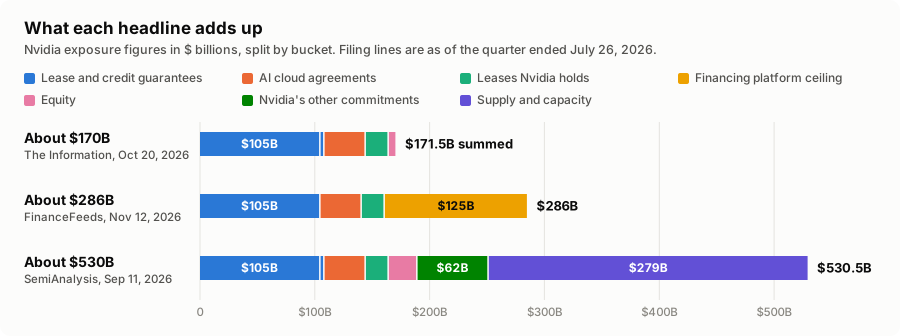
Filing lines: Nvidia 10-Q, quarter ended July 26, 2026. Headline figures: The Information (Oct 20, 2026), FinanceFeeds (Nov 12, 2026), SemiAnalysis (Sep 11, 2026), as reported. Bucket splits are my reading.
| Headline | Source and date | Arithmetic | What it counts that the others do not |
|---|---|---|---|
| About $170 billion | The Information, October 20, 2026, as summarized in a Substack post dated October 23, 2026 | Up to $164.5 plus more than $7 of direct equity, which the post adds to $171.5 | Equity in providers |
| About $286 billion | FinanceFeeds, November 12, 2026 | $36 plus $20 plus $105 plus up to $125, which is $286 | A $125 billion “up to” ceiling on a financing platform |
| About $530 billion | SemiAnalysis, as reported by AI Weekly, September 11, 2026 | Four named lines ($279, $108.5, $36, $20) total $443.5. The article leaves about $86.5 unitemized | The $279 billion of supply commitments |
I could not open the original articles, so I read each figure secondhand and rebuilt the arithmetic from the filing.
The $170 billion figure. The post splits it into up to $164.5 billion of guarantees and other commitments, plus more than $7 billion of equity. It does not itemize the $164.5 billion. In the 10-Q, $108.5 billion plus $36 billion plus $20 billion adds to $164.5 billion. The match is my reading, not the outlet’s statement.
Look at the $20 billion. Nvidia is the tenant on those leases and expects to reassign them. Until it does, the obligation is Nvidia’s own, and it promises nothing to a GPU cloud.
The $286 billion figure. It uses the $105 billion Ohio guarantee and leaves out the $3.5 billion of lease guarantees. Its largest piece, up to $125 billion, is a ceiling on a financing platform. Yahoo Finance (November 13, 2026) says Nvidia may backstop up to $125 billion of it.
The 10-Q has no $125 billion figure. It says Nvidia signed memorandums of understanding in August 2026 with several capital providers to mobilize more than $500 billion of third-party capital, and that these may not lead to definitive agreements. It adds that Nvidia may, at its option, provide limited residual-value support for a portion of specific projects. CIO (November 14, 2026) says the platforms are unsigned. The largest block in that total has no signed paper behind it.
The $530 billion figure. SemiAnalysis named four lines and left about $86.5 billion unitemized (as reported by AI Weekly). The 10-Q has four more lines: $29, $25, $25, and $8 billion. They add to $87 billion. I think that is the gap, but no source says so.
Adding every line in the filing: $366 plus $56 plus $108.5 is $530.5 billion. About $25 billion of that is committed equity.
Each figure answers a different question. The $530 billion figure asks what Nvidia has committed to spend. The other two ask what it has promised to back.
Where your deal sits
Of the $108.5 billion in signed guarantees, $105 billion covers one customer’s leases at one Ohio campus, and the first phase is not expected until fiscal 2029. The pieces that touch GPU clouds are the $3.5 billion of lease guarantees and the $36 billion of AI cloud agreements. Those are the two lines to read on November 17.
The 10-Q does not name the providers behind either line. CIO makes the same point (November 14, 2026). Only your provider can say whether it is one of them.
You may not see the Nvidia agreement, and it can still matter. Suppose your provider borrowed against its hardware. The lender priced that loan on the provider’s contracted revenue. If part of that revenue is an Nvidia agreement to take unused capacity, the agreement is part of your counterparty’s credit. Colette Kress, quoted by CIO on November 14, 2026, called this kind of arrangement “a minimum revenue guarantee that gives lenders the confidence to underwrite the project.”
A guarantee is worth what the guarantor will pay when asked. A lender who values it lower can reprice, or ask for prepayment on events the loan documents define. You would see that as a price change or slower expansion.
What to ask your provider this week
- What share of your contracted capacity or revenue is covered by an agreement with Nvidia? Is it a purchase of unused capacity, a lease guarantee, or equity?
- Is any hardware or data center lease financed on the strength of that agreement? Which lender, and what does the loan require if the agreement ends?
- What are the termination and change-of-control terms on Nvidia’s side? CoreWeave’s filing shows 30 days on breach and 90 days on an unresolved insolvency proceeding, plus a delivery and availability condition. Ask what yours say.
- When does the agreement end? CoreWeave’s runs to April 13, 2032. If your contract outlasts the agreement behind it, the last years of your term are unsupported.
- What happens to my capacity and my price if the agreement is cut or not renewed? Get the answer in the contract, not on a call.
- Does my contract survive assignment, a lender foreclosure, or an insolvency? The June vetting post covers assignment, lien, and escrow, so I won’t repeat it.
- Ask again after November 17, 2026, when Nvidia reports and files its next 10-Q.
What this does not mean
Guarantees cost Nvidia money only when a counterparty cannot pay. The lease guarantees are small against Nvidia’s size: $3.5 billion at most, with $712 million in escrow as of July 26, 2026, and exposure that falls as partners pay their landlords over five to seven years. The largest guarantee covers a campus whose first phase is expected in fiscal 2029. Most providers’ contracts will keep running as written.
Check which of yours lean on the backing. It is easier before you sign or renew.
Sources: Nvidia Form 10-Q for the quarter ended July 26, 2026, signed August 26, 2026 (SEC EDGAR, accession 0001045810-26-000075); CoreWeave Form 8-K filed September 15, 2025 (accession 0001769628-25-000047); CoreWeave Form 10-Q for the quarter ended September 30, 2026 (accession 0001769628-26-000465); Yahoo Finance, November 13, 2026; FinanceFeeds, November 12, 2026; CIO, November 14, 2026; SemiAnalysis as reported by AI Weekly, September 11, 2026; the AI-RTZ Substack, October 23, 2026, citing The Information, October 20, 2026. Outlet figures are as reported. Notes marked “my reading” are mine.